
Introduction
The CRISPR Babies: Science or Ethical Failure?
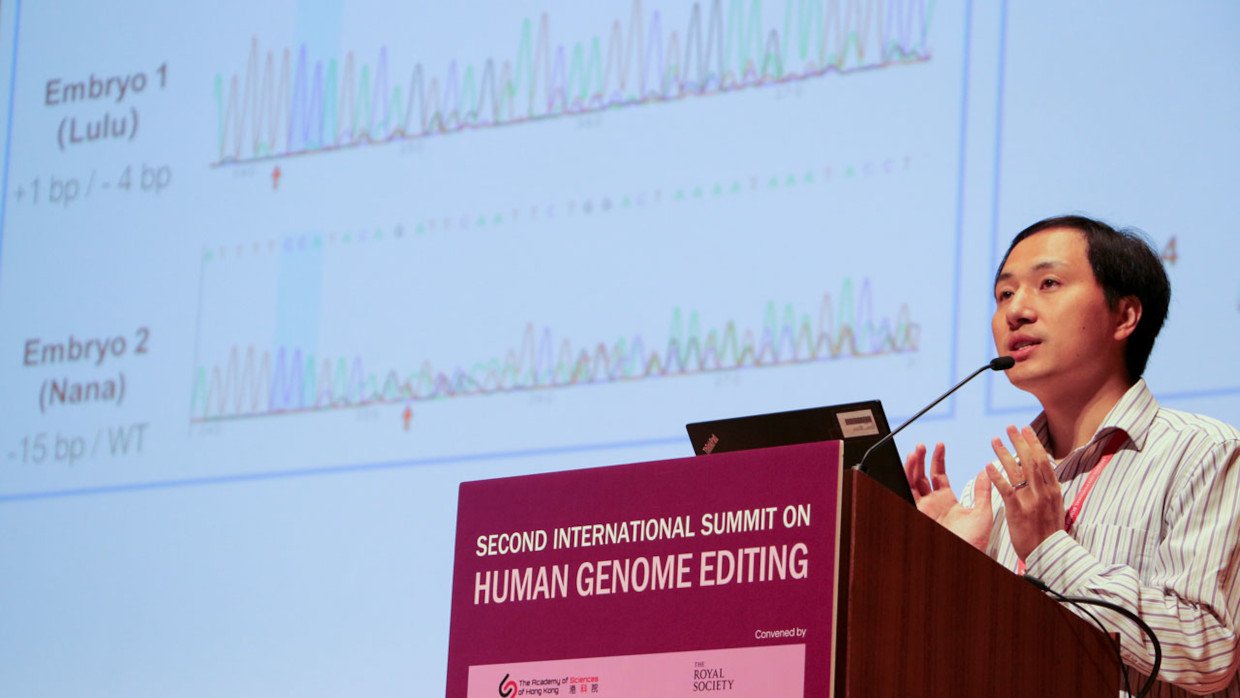
In 2018, the world of science was shaken by an announcement that felt like it had arrived too early—almost as if the future had been forced into the present before humanity was ready. A little-known Chinese scientist, He Jiankui, claimed that he had done something no one had ever done before. He had created the world’s first genetically edited human babies.
Not in theory.
Not in a controlled laboratory experiment.
But in reality!
Two children, born with altered DNA.
Their names, he said, were Lulu and Nana.
At first, the claim carried the weight of a scientific breakthrough. For decades, scientists had imagined a world where genetic diseases could be eliminated before a child was even born. A world where medicine was no longer reactive, but preventive at the most fundamental level—written directly into the code of life itself. It was a powerful idea, one that promised to reshape humanity.

But within hours, that sense of awe turned into something else entirely.
Disbelief. Concern. And then, outrage.
Because this was not just a breakthrough. It was a boundary being crossed.
To understand why the reaction was so intense, one must first understand the technology at the centre of it all: CRISPR. Often described as “genetic scissors,” CRISPR allows scientists to cut and modify DNA with remarkable precision. It has the potential to cure genetic disorders, transform agriculture, and revolutionise medicine. In many ways, it represents one of the most powerful scientific tools ever created.
But power, especially of this kind, comes with consequences.
Editing genes in an adult to treat disease is one thing. It affects only that individual. But editing an embryo is different. The changes become permanent—not just for the individual, but for every generation that follows. It is, in effect, a rewrite of human inheritance.
And until that moment in 2018, it was widely understood that such actions required extreme caution—if not outright restraint.
He Jiankui chose otherwise.
His experiment focused on a gene known as CCR5, which plays a role in allowing HIV to enter human cells. By disabling this gene, he hoped to make the children resistant to the virus. On the surface, the intention appeared compassionate. Preventing disease, after all, is one of the core goals of medicine.
But the reality was far more complicated.
The father involved in the case was HIV-positive, but existing medical techniques already made it possible to prevent transmission to the child with a high degree of safety. Gene editing was not the only option—it was not even the necessary option. It was, instead, an experimental one.
More troubling still was the way the experiment was conducted.
It was done in secrecy. Ethical guidelines were bypassed. The participants were not fully informed of the risks involved. And despite the uncertainty surrounding the technology, the edited embryos were implanted, leading to the birth of the twins.
At that moment, science had stepped into territory that many believed it was not yet ready to enter.
When He Jiankui revealed his work—not through peer-reviewed research, but through a video and a conference presentation—the reaction was immediate and global. Scientists across the world condemned the experiment. Leading voices in genetics and bioethics described it as reckless, irresponsible, and deeply unethical.
The concern was not simply about what had been done, but how it had been done.
CRISPR, while powerful, is not perfect. It can introduce unintended changes in DNA—mutations that may have unpredictable consequences. These changes could affect not just the children, but their descendants as well. What had been presented as a medical advancement suddenly looked more like a gamble with human life.
And this is where the story becomes more than just scientific. It becomes philosophical.
At its core lies a question that extends far beyond laboratories and research papers: just because something is possible, does that mean it should be done?
He Jiankui defended his actions. He argued that he was pushing science forward, that he was helping families, that he was opening the door to a better future. But for many, these justifications were not enough. They saw a scientist driven not by necessity, but by ambition—a desire to achieve something historic, regardless of the cost.
The consequences followed swiftly. Chinese authorities launched an investigation, and within a year, He Jiankui was sentenced to three years in prison for illegal medical practices. His career was effectively over. The experiment was halted. And the lives of the children involved became a subject of global concern and uncertainty.
Yet the most significant impact of this event was not confined to one individual.
It forced the entire scientific community—and indeed the world—to confront a new reality. Human genetic editing was no longer a distant possibility. It had already begun.
Since then, regulations have tightened. Ethical frameworks have been strengthened. Discussions about the limits of science have become more urgent and more complex. But the technology itself continues to evolve. CRISPR is becoming more precise, more accessible, and more powerful with each passing year.
Which raises an uncomfortable question: if the risks decrease, will the temptation return?
The story of He Jiankui is not just about what happened in 2018. It is about what comes next.
It is also, perhaps unexpectedly, a powerful lesson for students.
Because beyond the headlines and controversy lies a perfect example of how complex arguments are built and evaluated. This case brings together ethics, evidence, and debate in a way that mirrors the demands of academic work. It challenges us to weigh intention against consequence, innovation against responsibility, and possibility against morality.
In academic writing, strong arguments are not built on bold claims alone. They require evidence, critical evaluation, and an understanding of multiple perspectives. The global reaction to this experiment demonstrates exactly that. Scientists did not reject the idea of gene editing itself—they rejected the way it was applied, the lack of necessity, and the absence of ethical rigour.
In that sense, this is not just a story about science.
It is a case study in critical thinking.
And perhaps that is what makes it so important.
Because the next scientist may not make the same mistakes. They may be more careful, more precise, more convincing. And when that happens, the debate will not be about whether we can edit human life—but about how far we are willing to go.
The line that He Jiankui crossed may one day be redrawn.
But whether it should be—that remains a question for all of us to answer.