
Introduction
Imagine waking up tomorrow and seeing your neighbour dancing in the street.
Not dancing for fun. Not dancing at a festival. Not dancing to music.
Just dancing.
By evening, more people have joined. By the end of the week, dozens are dancing. Soon, the number may have reached hundreds. Some collapse from exhaustion. Some cry for help. Some accounts even say people died.
It sounds like fiction. However, the Dancing Plague of 1518 was recorded as a real historical event.
More than five hundred years later, it remains one of the strangest mysteries in European history.
What Was the Dancing Plague of 1518?
The Dancing Plague of 1518 began in July 1518 in Strasbourg. At the time, Strasbourg was part of the Holy Roman Empire. Today, it is located in France.
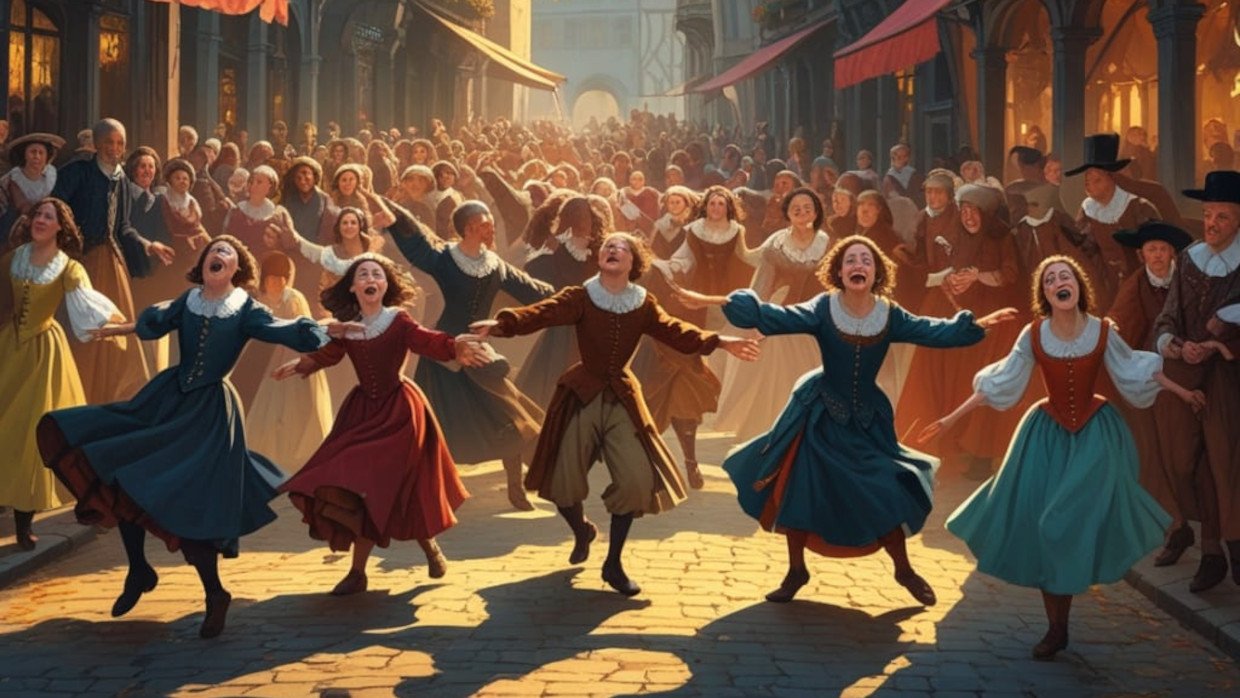
According to historical accounts, a woman known as Frau Troffea stepped into the street and began dancing. There was no celebration. There was no public performance. There was no obvious reason.
She simply started dancing.
Witnesses said she appeared unable to stop. She danced for hours. Then she danced for days. When exhaustion forced her to collapse, she later began again.
Soon, others joined her.
Within a week, more than thirty people were reportedly dancing. By August, the number may have grown much larger. Estimates vary widely. Some accounts suggest around one hundred people. Others suggest several hundred.
What makes the Dancing Plague of 1518 so disturbing is not just the dancing. It is the suffering.
Many dancers did not seem happy. Some screamed. Some cried. Some were in pain. Their feet reportedly bled. Their bodies shook. Yet they continued.
This was not dancing as joy. It was dancing as compulsion.
How Did Strasbourg Respond?
The authorities in Strasbourg did not understand what was happening.
That is important. In 1518, people did not have modern medicine. They did not understand psychology, infectious disease, or neurological disorders as we do today.
Local physicians blamed “hot blood”. This was a medical idea from the time. They believed the body had become overheated or imbalanced.
So, officials tried a strange cure.
They decided the dancers should dance the illness out of their bodies.
The city arranged for musicians. Stages were built. Professional dancers were hired. The intention was to help the afflicted recover.
However, the plan may have made things worse.
Instead of reducing the outbreak, public dancing seemed to encourage it. More people joined. The Dancing Plague of 1518 became a civic crisis.
Eventually, officials changed their approach. Some dancers were taken to a shrine dedicated to St Vitus. In popular belief, St Vitus was linked to dancing curses and nervous disorders.
Religious rituals followed. Then, by September, the outbreak slowly faded.
As mysteriously as it began, it ended.
What Caused the Dancing Plague of 1518?
The cause of the Dancing Plague of 1518 remains uncertain.
That uncertainty is part of what makes the event so powerful. Historians have evidence, but not enough for a final answer.
One theory involves ergot poisoning. Ergot is a fungus that grows on rye and other grains. It can produce toxic effects, including hallucinations and convulsions.
Since contaminated grain was a real problem in parts of medieval and early modern Europe, this theory may sound convincing.
However, many experts doubt it.
Ergot poisoning can cause strange symptoms. Yet it is unlikely to make people dance for days or weeks. It also does not easily explain why so many people behaved in such a similar way.
Another explanation is mass psychogenic illness. This is sometimes called mass hysteria, although that older phrase can be misleading.
Mass psychogenic illness occurs when psychological distress spreads through a group. It can produce real physical symptoms. The symptoms are not fake. However, they do not begin with a virus, poison, or visible injury.
This theory fits the context of Strasbourg.
The region had suffered famine, disease, poverty, and fear. People lived under severe pressure. They also believed deeply in curses, saints, and divine punishment.
In that world, the fear of a dancing curse could feel real. Once one person began dancing, others may have interpreted it through shared belief. Fear spread. Behaviour spread. The body followed the mind.
The Dancing Plague of 1518 may therefore show how social pressure, religious belief, and psychological distress can combine.
What If the Dancing Plague Happened Today?
If hundreds of people began dancing uncontrollably today, the world would react instantly.
Doctors would search for disease. Governments would investigate public safety. Social media would spread videos within minutes. News channels would report every detail.
Yet in 1518, people had fewer tools. They had faith, local medicine, rumour, and fear.
That does not make them foolish. It makes them human.
They tried to explain the Dancing Plague of 1518 using the ideas available to them. Their answers reflected their world.
This is why context matters in history.
We cannot understand the past by judging it only through modern eyes. We must ask what people believed, feared, and knew at the time.
Why the Dancing Plague of 1518 Matters for Students
The Dancing Plague of 1518 is more than a strange story. It is also a useful lesson for students.
First, it teaches the value of evidence.
Many explanations have been offered. Some are dramatic. Some are scientific. Some are religious. However, a strong academic argument cannot simply choose the most exciting theory.
It must ask a better question.
Which explanation is best supported by the available evidence?
Second, the Dancing Plague of 1518 teaches critical thinking.
A mystery does not automatically require a supernatural explanation. At the same time, a modern explanation should not ignore historical belief.
Good academic writing avoids both errors.
It does not jump to conclusions. It compares ideas. It tests claims. It explains uncertainty.
Third, this event shows why context is essential.
The people of Strasbourg lived through hardship. Their world included famine, disease, religious fear, and limited medical knowledge. Without those details, the Dancing Plague of 1518 becomes only a bizarre anecdote.
With context, it becomes a serious historical problem.
A Mystery That Still Moves
More than five centuries after Frau Troffea stepped into the street, historians still debate what happened.
Was it mass psychogenic illness? Was it poisoning? Was it a neurological condition? Was it shaped by religious fear?
Nobody knows for certain.
Yet that uncertainty is valuable.
History is not always a list of final answers. Sometimes, it is a discipline of careful questions.
The Dancing Plague of 1518 reminds us that people in the past lived through fear, confusion, and crisis. They tried to make sense of events they could not control.
In that way, the story still feels close to us.
Because fear still spreads. Belief still spreads. Behaviour still spreads.
And sometimes, history leaves us with a question that refuses to stop moving.
How did a city begin dancing?
And why could it not stop?
Source Notes
The broad account of Frau Troffea, Strasbourg, the “hot blood” explanation, musicians, and the shrine of St Vitus is supported by History.com’s overview of the event. John Waller’s articles in The Lancet and PubMed-indexed work support the mass psychogenic illness interpretation and note the broader history of dancing mania. The Public Domain Review also discusses the 1518 outbreak and its historical strangeness.
Need Help Building Stronger Academic Arguments?
At Acadex, we help students develop clearer, stronger and more evidence-based academic work. Whether you need support with essay structure, critical analysis, source evaluation, research papers, dissertations or editing, our work is designed to help you understand how strong academic arguments are built.
Every model paper is human-written, plagiarism-free and created for guidance, learning and reference.
Acadex - helping students move from claims to evidence, and from description to analysis.